|
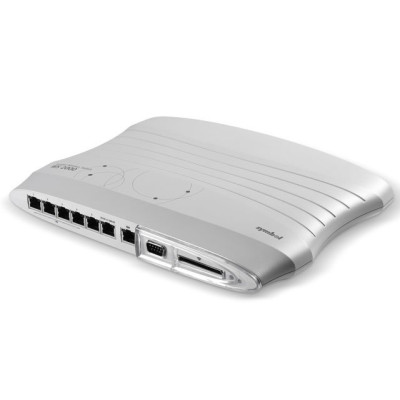
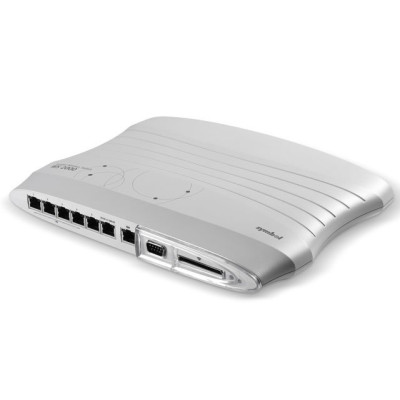
WS 2000 Wireless Switch
Integrated Wired and Wireless Networking for Branch Office and
Small/Medium Enterprises
The WS 2000 Wireless Switch from Symbol Technologies is an
integrated wired and wireless networking solution, priced and
designed to meet the needs of healthcare clinics, schools and
colleges to warehouses, branch offices of government agencies,
retail stores, manufacturing plants and more. Built on the same
centralized packet switching architecture as Symbol's award-winning
WS 5000 Wireless Switch, the WS 2000 offers enterprise class
security (802.11i, site-to-site IPSec VPN), public/private network
segmentation and 802.11abg standards support and provides:
- Extensive wireless LAN functionality and high performance
- Power and simplicity of centralized remote management
- Ability to scale to support future growth
…Investment protection and network simplicity.
All-in-One Integrated Wired and Wireless Networking
The need to purchase and manage additional network equipment is
eliminated with the elegant all-in-one design of the WS 2000.
Support for multiple wireless LAN protocols (Wi-Fi® IEEE
802.11b, 802.11a, 802.11g), as well as integrated Ethernet
switching (6 LAN ports), routing (RIP, Static Routes), Gateway and
Power-over-Ethernet (PoE) simplifies network deployment and
management, and reduces capital expense. Functionality includes an
integrated Stateful Packet Inspection Firewall, Network Address
Translation (NAT), DHCP server (on multiple subnets), and WAN
connectivity support for flexible low cost installation.
Second-Generation Wireless LAN: the Power of Centralized
Intelligence
The WS 2000 offers the power and cost-efficiencies of
second-generation wireless networking. Intelligence previously
distributed and duplicated throughout first-generation access
point-based wireless LANs is centralized and aggregated in the WS
2000 Wireless Switch, delivering unprecedented power and control,
and reduced deployment and management costs. Instead of traditional
access points, the WS 2000 works in conjunction with low-cost
Access Ports, which are essentially ‘zero configuration' devices,
operational right out of the box, and can be mounted almost
anywhere—even inside ceiling tiles.
End-to-end layered security
WS 2000 supports a comprehensive suite of security
mechanisms—including access-control, IPSec VPN (site-to-site),
802.1X based authentication, and strong encryption. In addition,
the WS 2000 also integrates a Stateful Packet Inspection Firewall
for protection against various types of Denial-of-Service attacks
and filtering network traffic within the Local Area Network (LAN)
and between the LAN and the Wide Area Network (WAN). The result is
a layered security model that delivers robust end-to-end security.
The WS 2000 supports the best-in-class wireless security standards
of today (including 802.11i), and is easily upgradeable to
tomorrow's standards.
Centralized management
The WS 2000 simplifies day-to-day operations with unified
management of hardware, software configuration, and network
policies. Centralized management also enables the automatic
distribution of configurations to all Access Ports—eliminating the
need and the associated costs to configure and manage each access
point. The WS 2000 also simplifies wireless network deployment
across multiple locations (for example, multiple retail stores,
restaurants or branch offices), delivering network design
consistency and simplicity, as well as the ability to centrally
manage from a regional Network Operations Center (NOC) or a data
center.
Scaleable and easy to upgrade
The WS 2000 Wireless Switch System is designed to grow and adapt
to changing network and organizational needs. Adding capacity and
new functionality is easier and less expensive than an access
point-based wireless LAN. Each WS 2000 supports up to six Access
Ports and four wireless LANs, each with its own security and
network policies. The plug-and-play Access Ports are ready to
install right out of the box. Just attach directly to the WS 2000
or to your layer 2 LAN with Power-over-Ethernet and the network is
immediately operational—LAN network integration is transparent. And
upgrading to support newer standards in the future is fast and
easy.
Lower total cost of ownership—outstanding investment
protection
The WS 2000 removes the overhead and complexity of first
generation access point-based wireless LANs, delivering a wireless
network that is less expensive to implement and manage. The
extensive functionality, expandability, and centralized management
eliminate the time and management costs associated with access
point-based solutions, providing a lower total cost of ownership.
And the flexibility to support the standards of today and tomorrow,
as well as the legacy wireless networks of yesterday, protects this
valuable investment.
Extensive WLAN Functionality
The comprehensive feature set of the WS 2000 provides full
control over wireless LAN traffic to provide peak performance.
Extensive wireless LAN functionality enables you to maximize
bandwidth and throughput, secure network traffic, prioritize voice
traffic, conserve power on mobile devices, and provide dependable
connection speeds for users in challenging wireless
environments.
Scalable Radio Architecture
Each WS 2000 supports up to six single or dual-band Access Port
radios (802.11b and 802.11abg) in the 2.4 and 5 GHz
frequencies—offering the broadest radio technology support in the
industry. The WS 2000 supports a total of four wireless LANs.
Access Ports: Next-Generation Wireless Access Devices
Access Ports bring a new level of simplicity to wireless network
implementation and management, as well as an unprecedented upgrade
capability. Access Ports are easily upgraded with new features and
functionality via the WS 2000, providing excellent investment
protection. A wide range of 802.11a, 802.11b and 802.11g external
antenna options enables the design of coverage patterns for the
most challenging environments. Each Access Port/radio supports up
to four wireless LANs.
The Access Port AP300 supports simultaneous 802.11bg and 802.11a
operations and aids in high bandwidth applications. Support for
Dynamic Frequency Selection (DFS) and Transmit Power Control (TPC)
is included with the AP300 for regulatory compliance and radar
detection and avoidance. Both the 802.11bg and 802.11a radios
support four BSSIDs (which are mapped to four ESSIDs).
Voice Prioritization
The WS 2000 provides voice prioritization capabilities for
devices such as VoIP phones, guaranteeing priority for voice
traffic during periods of network congestion.
Power Saving for Client Devices
The Power Save Protocol (PSP) polling feature enables devices to
maximize battery life and maintain application performance. The
implementation allows devices to conserve power between wireless
transmissions and also ensures that packets are stored and reliably
delivered when the device awakens.
Virtual AP Enables True Virtual Wireless LANS
Virtual AP enables the wireless LAN to be segmented into true
multiple broadcast domains—the wireless equivalent of Ethernet
VLANs—providing the ability to map multiple ESSIDs (Extended
Service Set Identifiers) to multiple BSSIDs (Basic Service Set
Identifiers).
Virtual AP provides complete control over broadcast traffic.
Control of broadcast traffic, including network level messages, is
extremely important because of its potential negative effect on
performance. Intelligent control of broadcast forwarding through
proxy ARP and other mechanisms ensures that only the intended
recipients receive broadcast traffic. The resulting reduction in
traffic maximizes bandwidth and network throughput; device battery
life and overall performance are improved with the elimination of
the processing of messages intended for other recipients; and the
possible compromise in confidentiality and security of messages is
eliminated since broadcast messages can no longer reach the wrong
recipients.
Load Balancing and Pre-emptive Roaming
Normal roaming does not occur until the device connection has
reached a minimum connection speed of 1 Mbps—normally well beyond
the boundaries of a cell and approximately halfway through an
adjacent cell. Two features, client load balancing and pre-emptive
roaming, work hand-in-hand to ensure that devices roam before the
connection quality erodes, providing users with more consistent
connection speeds for smooth application performance. The WS 2000
provides the information needed for roaming decisions, ensuring
that critical wireless connections—such as real-time voice and data
connections—are maintained
Transmit Power Control
Transmit Power Control minimizes radio interference for sites
that require a very dense population of radios (Access Ports) to
support bandwidth requirements. The transmit power along with
antenna gain can be set on all supported Access Ports.
Multicast Masking
This feature enables multicast traffic to be sent to intended
clients without any queuing, providing essential support for
push-to-talk and other multimedia applications.
Proxy ARP
Proxy ARP enables the WS 2000 to respond to ARP requests on
behalf of a mobile client, acting as the client's agent or Proxy.
No longer burdened with the processing of ARP requests, the mobile
client can temporarily suspend the WLAN adapter. The result is
substantial savings of battery power on the client device, while
preserving the integrity of the IP connection.
Storage of Software Update Packages for Client Devices
With the WS 2000 and AirBEAM® Smart, managing and
updating software on Symbol mobile devices is fast, easy—and
automatic. The WS 2000 acts as an FTP server, storing software
updates via a CompactFlash™ card. AirBEAM Smart, Symbol's software
management program resident on Symbol mobile devices, accesses the
WS 2000 to automatically download and install everything from new
or updated wireless applications and drivers to operating systems
on boot up.
End-to-End Layered Security
There is no element of networking—wired or wireless—more
important than security. The WS 2000 offers an integrated firewall
as well as a complete end-to-end layered security model that
supports all of today's wireless security standards, and is easily
upgradeable to support the standards of tomorrow. Users can
configure security policies that specify the correct level of
control for users, applications, and devices within those
groups.
Network Access Control
Layer 2 Access Control Lists provide filtering for advanced
network traffic control, enabling administrators to forward or drop
packets based on protocol type or MAC Addresses.
Stateful Packet Inspection Firewall
Firewalls prevent unauthorized access to and from a private
network by inspecting data packets that leave and enter the
network, blocking data packets that do not meet certain criteria.
In addition, firewalls prevent various types of Denial-of-Service
attacks initiated both internally and externally.
The integrated firewall in the WS 2000 is always enabled on the
WAN interface by default, providing instant protection against
intruders and a wide variety of attacks. The Stateful Packet
Inspection Firewall offers advanced packet inspection and
filtering—much stronger protection than standard simple packet
inspection engines. "Stateful inspection" keeps track of
information in the packet header, such as Sequence numbers,
source/destination IP address, source/destination port numbers, as
well as the state of all TCP sessions passing through the firewall.
The firewall checks for compatibility between the header of the
responding packets (TCP Acks) and the associated session
information in the inspection table. If the information does not
match, the packet is dropped.
The default Firewall settings also protect against the following
types of attacks:
- IP Spoofing
- Ping of Death
- Land Attacks
- IP Reassembly attacks
Configurable filters guard against other types of attacks
including Syn Flooding, Source Routing, Winnuke, FTP Bounce,
Sequence Number Prediction, IP Unaligned Timestamp, and Mime Flood
Attack. Defense against a total of more than 50 types of attacks is
provided by WS 2000.
Between each of the available subnets, the WS 2000 also provides
filtering capabilities based on protocol, port and IP source and
destination addresses.
802.1x/Extensible Authentication Protocol (EAP)
802.1x and Extensible Authentication Protocol (EAP) work
hand-in-hand, providing the infrastructure for robust
authentication and dynamic key rotation and distribution. EAP
provides a means for mutual authentication. Authorized users
identify themselves to the wireless network, and the wireless
network identifies itself to the user—ensuring that unauthorized
users cannot access your network, and authorized users do not
inadvertently join a rogue network. A wide variety of
authentication types can be used—from user name and password to
voice signatures, public keys, and biometrics, with the ability to
upgrade to support future authentication types. And dynamic
key rotation and distribution provides a new encryption key per
user per session, greatly increasing the strength of the chosen
encryption algorithm (WEP, AES or TKIP) used to encode data. The WS
2000 supports a variety of EAP methods, including TLS, TTLS, PEAP
and SIM.
Kerberos
The industry-standard Kerberos protocol meets all of the
requirements for scalable, effective security in a mobile
environment. Kerberos features mutual authentication and end-to-end
encryption. All traffic is encrypted and security keys are
generated on a per-client basis, keys are never shared or reused,
and are automatically distributed in a secure manner. WS 2000
requires an external Key Distribution Center (KDC), such as a
Windows 2000 server.
Encryption
Encryption ensures that data privacy is maintained while in
transmission. As a common rule, the stronger the encryption, the
more complex and expensive it is to implement and manage. The WS
2000 supports a range of encryption options (including AES and 3DES
that support wireless networking, SNMP access and site-to-site VPN)
that provide basic to strong encryption techniques, providing the
flexibility to select the right level for your data.
Wired Equivalent Privacy (WEP)
The 802.11 Wired Equivalent Privacy (WEP) provides static key
encryption—a single key is distributed to all users for encryption
and decryption of data. WEP generates either a 40- or 128-bit key
using the widely used RC-4 encryption algorithm. WEP allows full
interoperability with legacy clients and provides basic
over-the-air security in less-critical environments, such as an
open public-access application.
WPA—Temporal Key Integrity Protocol (TKIP)
WPA-TKIP addresses well-known vulnerabilities in WEP encryption.
TKIP provides key rotation on a per-packet basis along with Michael
message integrity check (MIC), which determines if data has been
tampered or corrupted while in transit. This robust method of
encryption provides a higher level of protection for your data and
protects your network from a variety of types of attacks.
WPA2 (AES/CCMP)
WPA relies on RC4 and TKIP. In order to completely eliminate the
WEP related flaws, IEEE recently ratified a new security standard,
802.11i (termed WPA2 by the Wi-Fi Alliance). WPA2 specifies the use
of stronger cipher systems such as AES (Advanced Encryption
Standard) and a security protocol called CCMP (Counter Mode CBC MAC
Protocol). CCMP uses AES for encryption and a well-proven method
called CBC-MAC (Cipher Block Chaining Message Authentication Code)
to compute the message integrity check (MIC) (for data integrity
checks). CCMP in a sense is the equivalent of TKIP used in the
original WPA but much stronger.
As part of the WPA2 implementation, support for PMK (Pairwise
Master Key) Caching, Pre-Authentication, and "Opportunistic" PMK
Caching is available, enabling fast roaming of mobile clients
between Access Ports. These mechanisms basically act by foregoing
either the 802.1X part of the authentication or the 4-way handshake
associated with CCMP message exchanges between the client and the
Access Port.
KeyGuard™—MCM
Similar to WECA's version of TKIP, KeyGuard provides a different
key for every packet of data, but uses a different version of
message integrity check (MIC) to determine if data has been
tampered or corrupted during transmission. KeyGuard was developed
by Symbol prior to WPA. It is supported on Symbol mobile clients
and due to its small footprint, has the advantage of being
supported even in older DOS based devices.
IPSec VPN (Site-to-Site)
Virtual Private Networking (VPN) provides a cost-effective,
secure solution for businesses to take advantage of the public
Internet instead of dedicated leased WAN links to transmit
information between remote branch offices (Intranet) or with
external customers/partners (Extranet).
The WS 2000 supports IPSec (Internet Protocol Security) based
VPN for securing communication between a WS 2000 in a branch
location and another VPN Gateway at the main office. The
implementation in WS 2000 includes a complete IPSec engine, IKE
engine, DES/3DES/AES encryption and NAT Traversal support.
Wired Networking Services
In addition to wireless network connectivity, data switching
capabilities are also provided for wired devices (such as Store
Servers, wired Point-of-Sales Systems, wired printers, etc.) that
are connected to any of the six Ethernet ports on the WS 2000.
Virtual LANs
Up to four independent subnets (broadcast domains) can be
configured in the WS 2000. The six physical ports and four wireless
LANs are mapped to one of the four subnets. Separate IP addressing
and outbound network policies (filtering traffic based on Protocol
type and Port ranges, IP Source and Destination addresses or
completely blocking traffic between subnets and the WAN) can be
applied on a per subnet basis. This provides a great deal of
flexibility in segmenting and securing the network.
Routing
The WS 2000 supports Layer 3 services. It supports Routing
Information Protocol (RIP) v1 and v2. The primary benefits of RIP
are ease of configuration and suitability for small networks (less
than 15 hops). If RIP is enabled on any of the four private
interfaces, RIP broadcasts are periodically sent over that
interface, and the routing table is also updated based on the
broadcast received on that interface from other connected routers.
Static routes can be configured for each IP interface on the
private side as well.
Integrated Gateway
The WS 2000 integrates gateway functionality for ease of
provisioning network services—Network Address Translation (NAT),
DHCP Server, Firewall—for SMBs.
DHCP Client and Server
The WS 2000 offers integrated DHCP services for all four of its
subnets. The need to purchase, manage and maintain additional
network equipment to obtain this functionality is eliminated–saving
capital as well as operational expenses.
Each of the four private interfaces (Subnets 1-4) can be
configured as a static IP address or either as a DHCP (Dynamic Host
Configuration Protocol) client or a DHCP server. The WAN interface
can have a static IP address or be configured to be a DHCP
client.
If the interface is configured to be a DHCP client, the IP
address is obtained from an external DHCP server. If the interface
is configured to be a DHCP server, the WS 2000 serves (leases) IP
addresses to connected clients (wired or wireless). The scope of IP
addresses (the range) is configurable per subnet. The clients also
receive DNS configuration and default route information from the
DHCP server on the WS 2000.
The advanced DHCP configuration allows for specification of
lease time, WINS Server and static IP mappings (mapping individual
MAC addresses to specific IP addresses).
Network Address Translation (NAT) with Application Layer
Gateway (ALG)
With NAT, the IP addresses of client devices in the internal
network are invisible to the external world. Identity is protected,
while the client devices connect to the Internet through the WS
2000 as if directly on the Internet. The WS 2000 supports three
different NAT configurations:
- One-to-One
—A pool of available public IP address can be used to map to an
individual (internal) client IP address. One-to-one NAT translates
the IP address on behalf of the client.
- Many-to-One—The IP addresses for a group of mobile
clients in the internal network can be mapped to a group with a
single public IP address. The WS 2000 allows the range of IP
addresses in each of the three subnets to be mapped to the same (or
different) public IP address.
- Port Forwarding—This inbound network policy allows
communication from the public network to a computer on the internal
network via a specified port. Essentially, this allows the creation
of a tunnel through the firewall, between the computer on the LAN
and the Internet. This is useful, for example, to run a Web Server
(Port 80) or FTP Server (Port 23) using a single IP address. The WS
2000 also allows the port translation and forwarding of all
unspecified ports to a specific IP address on the internal
network.
Application Layer Gateways (ALGs) enable applications that embed
addressing information in the payload (such as FTP, Quicktime, Real
Networks, Net2Phone and Netmeeting), and protocols (such as PPTP,
L2TP, IKE and IPSec) to work when NAT is enabled. ALGs for over 40
different applications and protocols are supported.
WAN Connectivity
The integrated uplink 10/100 Ethernet Port enables the WS 2000
to connect to a WAN access device (such as a DSL or Cable modem, or
Frame Relay Access Device), enabling client devices to share
Internet connectivity.
In addition, the WS 2000 provides support for industry-standard
PPP (Point-to-point) and PPPoE (PPP over Ethernet) protocols. The
PPPoE protocol enables multiple LAN users to connect to the
Internet through a single DSL modem.
Ease of Management
The WS 2000 is easy to configure, and even easier to manage. The
configuration of any WS 2000 can be easily replicated for fast and
simple deployment of additional WS 2000 Wireless Switches. The
configuration file can be exported to a text file and directly
imported into the WS 2000, or published to a remote FTP or TFTP
server that is accessible to your WS 2000 Wireless Switches.
Firmware can be easily updated as well, either via FTP or TFTP
servers.
Support for different interfaces is provided to ensure a maximum
flexibility in configuring and managing the WS 2000:
- Command Line Interface (CLI)
—Designed with well-known industry semantics and provides complete
baseline management through the Telnet or Serial interfaces.
- Web-based Management—Provides anytime-anywhere
management with an intuitive, web-based (Java) GUI that supports
step-by-step, easy configuration of all the system features.
- Simple Network Management Protocol (SNMP)—The SNMP
implementation in the WS 2000 provides support for commands for
updating configuration and firmware files and allows for remote
monitoring of system health and key RF parameters. Supported MIBs
include:
- MIB II (RFC 1213)
- Ping and Traceroute MIB (RFC 2925)
- Symbol MIB (802.11 related)
The WS 2000 provides several key RF statistics that help in
real-time monitoring of the network health. These statistics (such
as throughput, percentage of retries, average signal strength and
SNRs on per MU, Access Port, and Switch basis) are updated
frequently and available via all supported interfaces (CLI, Web,
SNMP). Key system traps are also supported. Traps can be configured
when any of the key system performance parameters fall outside the
user configured bounds. The traps can be forwarded to any
enterprise management system and provide early notification of
network problems related to Access Port adoption, Mobile Unit
association and system resets.
|


 WS 2000 Specs